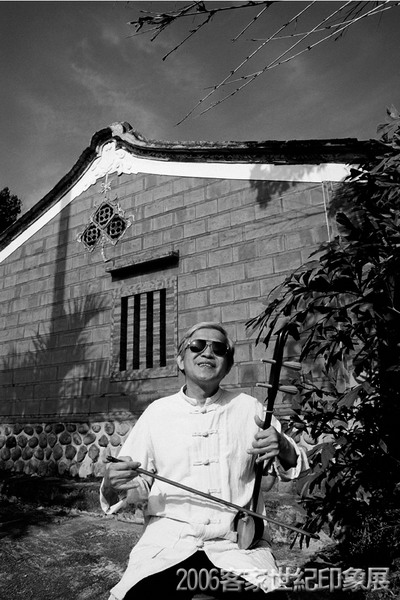
Chinese name: 徐木珍
Born: 1944
Died: Dec. 29, 2020
Birthplace: Hsinchu County (Northern Taiwan)
Hsu Mu-chen is a Taiwanese Hakka folk art master. His rich life history and performance experience have left a valuable testimony to the folk music of Hakka traditional society. He developed Hakka folk songs’ beautiful Hakka, music and culture, especially the casual mountain songs, to their fullest potential. For this, he became the first winner of the Hakka Contribution Award.
Hsu suffered from measles when he was a child. Due to a delay in diagnosis and treatment, he became blind in both eyes. From the age of seven, he began to learn Hakka traditional folk songs, and he studied how to play the erhu, sanxian and pipa instruments. His musical sense was excellent and his skills were superb. At the age of 13, he followed his older male cousin to sing everywhere for a living. His experience of singing for a living in his youth made him familiar with all kinds of folk tunes. He even integrated the "seven-character tune" that usually only appears in the songs of the Minnan dialect, into the nine-accent and 18-tune of Hakka music.
Hsu is not only good at many tunes of Hakka folk songs, but also proficient in playing various instruments, such as gongs and drums, the wood block, three strings, and yueqin. It can be said that he is a "one-person orchestra." He loves Hakka traditional folk songs, has a smooth singing style and can sing a wide range of tones. He can also sing while playing instruments and he is good at improvising the lyrics. His optimistic and lively personality is also reflected in his performance style. Therefore, his Hakka folk songs are loved by all walks of life. From his teenage years to his 40s, he recorded more than 100 Hakka folk song records.
In 2005, Hsu gathered his lifelong learning and released the album "String Poetry (弦詩)," which combines the music that is most precious to Hakka people and closest to their life, but is now at risk of being lost. The album presents Hsu’s unique performance technique, which is true to tradition and yet modern.
In 2007, Hsu collaborated with Hakka female singer Luo Si-rong (羅思容) to produce the song “Each Day,” which is about a woman trying to find her own song in her daily life, while living in a traditional society. The collaboration between the two breathed new life into a song that is rooted in Hakka traditional melodies.
Hsu dedicated his life to Hakka folk songs. The special instruments and timbres he developed were different from the charms of typical traditional instruments. In addition, his diligence in learning various music masters’ techniques helped him create his own unique aesthetic style. At the same time, he also left a footnote and testimony to the development of Hakka folk song culture in Taiwan’s history.