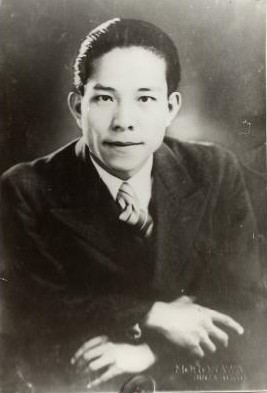
Chinese name: 江文也
Born: June 11, 1910
Died: October 24, 1983
Birthplace: Taipei City (Northern Taiwan)
Jiang Wen-ye was a Hakka composer, vocalist and teacher. His works contained a strong sense of his homeland Taiwan, religious sacred music and Chinese classical culture, setting the style for the modern music scene in Taiwan and China. Jiang also represented Japan in the art competition at the 1936 Berlin Olympics, where he won a medal and certificate for the best works outside the top three works, becoming the only Oriental in the Olympic art competition and the first Taiwanese to win a medal in the Olympics.
Jiang was born in Taiwan's Dadaocheng district during the Japanese colonial era. At the age of 13, Jiang's mother died, so he followed his eldest brother to study in Japan. After graduating, he entered the Musashi Higher Industrial School, according to his father's expectations. However, he used his spare time to study at the Tokyo Music School to learn vocal music as music was his interest.
After graduating from the industrial school, Jiang submitted application for becoming a singer after seeing Columbia Records Company was recruiting, and successfully obtained admissions. He later became famous in the Japanese music scene as a baritone. With his unique sensitivity to sound and his rich thoughts about his native land, Jiang won second place in the composing segment of an all-Japan music competition in 1934 with the orchestral piece he composed "Egret's Fantasy." Since then, he won the Japanese composing competition for four consecutive years, establishing his place in the Japanese composers’ world.
At the age of 26, Jiang adapted his debut piece, the piano composition "The Night in the City," which is based on his strong feelings for Taiwan, to an orchestral music piece titled "Formosan Dance." After passing through all the primary competitions in Japan, "Formosan Dance" was chosen to participate in the 1936 Berlin Olympics’ art competition, and won the Olympic "Special Award" for that work.
After that, Jiang was invited by the Taiwanese musician Ke Zheng-he (柯政和), to serve as a professor at the Music Department of Peiping Normal University; he settled in Beijing from then on. During this period, in addition to cultivating talents, Jiang also devoted himself to studying ancient music, folk music and ancient poetry. The period from 1938 to 1945 was his most productive period.
In 1957, political movements in mainland China frequently occurred. Jiang became caught up in the whirlpool of political struggles, losing his teaching job, opportunities to perform and rights to publish his works. However, he still did not give up his desire to create, and even completed several large-scale works.
One of the works, “The Third Symphony,” is based on Xie Xue-hong’s (謝雪紅) poems and shows the dissatisfaction of Taiwanese people towards colonialism. “The Fourth Symphony” was made to commemorate the success of the 300th anniversary of Zheng Cheng-gong’s (鄭成功) recovery of Taiwan (from the Dutch colonizers). In 1983, Jiang died in Beijing of illness. His last work was the symphony "Song of Alishan," which was based on the folk melody that his mother sang to him when he was a child.